

A simple orange opens the door to childhood memories of illness, migration, and a father’s quiet love. Evie Groch weaves past and present into a story of survival and celebration.
📬 Subscribe to Written Tales for new poems and stories.
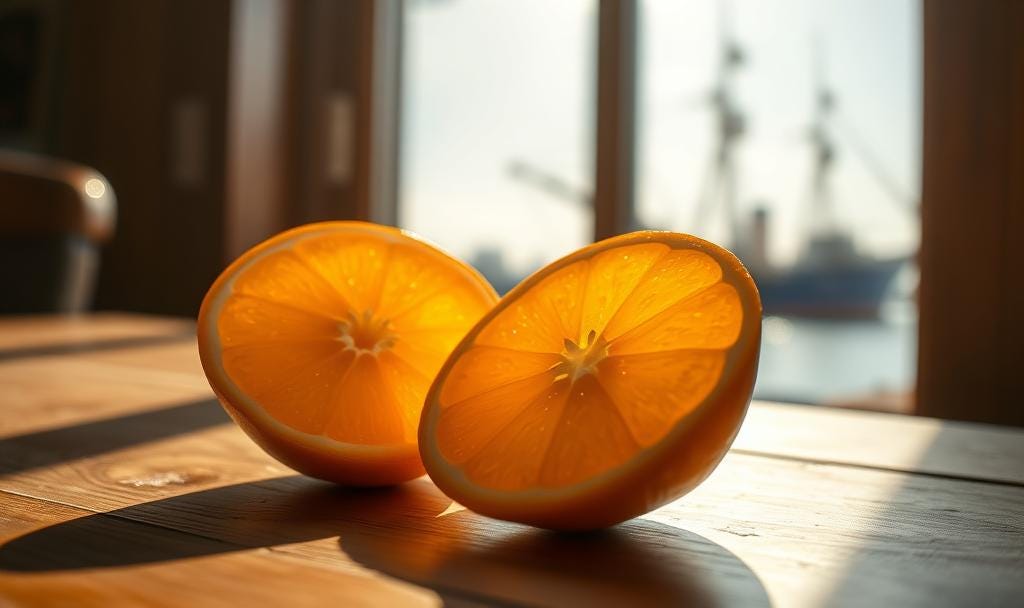
A simple naval orange, right here in front of me, bright, juicy, and a main ingredient for what I’m about to make to celebrate the Festival of Purim, something my parents had to do in secret in Eastern Europe. When I slice the orange open, I’m transported to the infirmary I was in during a sixteen-day voyage on a freighter from Bremen, Germany, to New Orleans, USA, my entry point. An infirmary like a cell. I had the measles. Couldn’t eat. Forlorn, isolated, and only three years old. What were they thinking? Anger rises in me yet. My father, my hero, sneaked in to my cell in the evenings with sweet, juicy oranges, something I could easily swallow.
“Hayale,” he called me, the diminutive for Haya, or Alive, Living in English. “Try these, or at least suck the juice out.” These golden orbs nourished me and became my diet. How I take them for granted now, these sunbaked treasures.
My nose twitches. Why now? Because I am remembering other smells on board, not so nice smells. God, I hated the urine-stained mattresses we slept on out of the infirmary. The smell nauseates me even today, having imprinted on my senses a stench steeped in poverty, rationing, refugees, and those of little hope. I still haven’t completely shed these labels after so many years. But luckily, there were other aromas to offset these. I can inhale them now in my mind. Strange smells, new to me, but more common to me now than ever before. How did they first reach me? When did I first taste the food connected to the smell? When did I accept them? It didn’t happen all at once.
Alvira Street, I think it was—the train station we got off at in Los Angeles after leaving New Orleans. Bold colors, piñatas, chilies, salsas, tortillas, guacamole all assaulted my senses. The downtown heart of the Mexican city. It was years before I tasted the foods these aromas came from. Too alien for my parents, who didn’t even know what to call them. I never won them over. It wasn’t until much later even I accepted these foreign foods. But then, like others, the craving started. How long can I go without needing to give in to a Mexican meal? Not very long, although I’m still not a big fan of cilantro, after so many years. From oranges to Mexican food. What was next? My name.
How did I lose my name? Am I still who I am with my name changed? Is it this way for all immigrants? I sometimes wonder if changing my name was a betrayal of sorts. Not on my part, because I had little to do with it. Was it a betrayal by my parents of our cultural heritage? Or was it simply a reach too far for assimilation?
My father entered the country as Yossel; in Poland and Germany, they called him Josef. Here it was immediately changed to Joseph. My mother came as Feige, or as Fania in Poland. Here she became Faye. I never knew how they liked their new packaging, but I don’t think it mattered to them. It was the entry price for relocation. What they called each other at home never changed, no matter where they lived.
They enrolled me in a private school on a scholarship for need, which had an opening for a kindergartner. To my surprise, there already was a Haya in the class. I wonder what turn my life would have taken had she not been there. There couldn’t be two. I guess that was the law back then. My teacher, either in her wisdom or because of her lack of sensitivity, reassigned me the name Hava, Eve in English. Would a one letter change really matter? In a few seconds, I was a new entity.
Five years later, at the naturalization ceremony for my parents and me, the three of us were sworn in and became legal citizens. Joseph, Faye, and Evelyn. Evelyn would appear on all my legal records and sound as foreign to me as a Greek name. But now, now that I have a say in how I’m referred to, I go by Evie (not E.V., but Ehvy). I continue to correct people who mispronounce it because that has become me… until the barista at Starbucks spells my name, and then someone else tries calling it out: Evvie, Eevy, Eeby, Edie, Eddie, Audie, Eva. Which will it be today? I even thought about coming up with a name just for me to use at Starbucks, but the baristas beat me to it. Since I speak Spanish with them, they named me Evita, and it fits. Problem solved—no mispronunciations. So, no more changes. Nothing left to assimilate.
All this memory floods out as I cut open an orange to make the filling for hamantaschen, my favorite treat to be eaten at the Festival of Purim, a festival I am free to celebrate in my adopted country under my new name.
✍️ About the Authors
Evie Groch has been in education all her life. Now retired, her love of travel and writing lured her over to the creative side, where she’s published in many genres.
Enjoyed this piece?
Inspired to share your own story? Submit your work to be featured in Written Tales. We’re here to showcase your voice and talent.
✨ Members: You can submit for free.
Non-members: You can submit with a small fee to help support future issues.
→ Submit Your Work (Members)
→ Submit Your Work (Non-Members)
📖 Join the conversation and explore more stories, poems, and ideas.
→ Explore the Magazine
Become Part of the Tribe
Your support fuels the creativity of our community. Subscribe today to get full access to exclusive works, writing tips, and a tribe of passionate creators.